
Carbide Erosion vs Abrasion: What’s the Difference?
Erosion and abrasion are both forms of wear. Both involve particles. Both shorten tool life. And yet, optimizing a tungsten carbide grade for one can actively work against performance in the other.
That’s the problem engineers run into when they treat the two terms as interchangeable. The failure modes look different, the material properties that resist them point in opposite directions, and choosing a grade based on the wrong mechanism is one of the more avoidable reasons carbide parts wear out faster than they should.
Here’s what actually separates the two, and what that means when you’re specifying a grade.
What Is Abrasive Wear in Carbide?
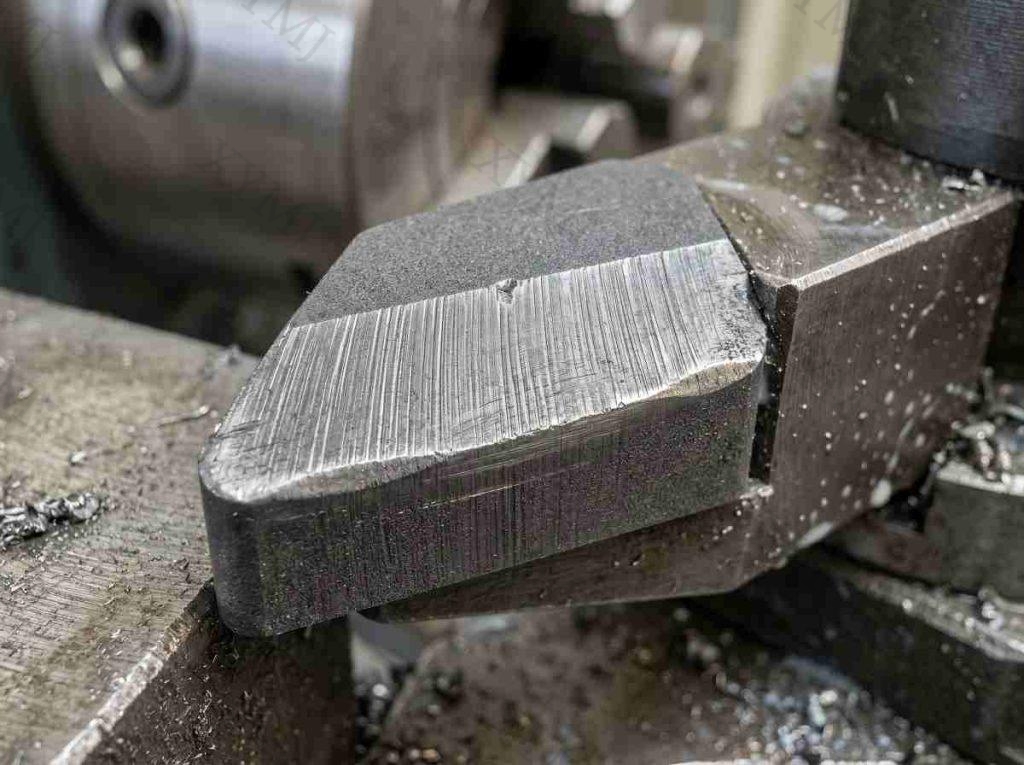
Abrasive wear happens when hard particles slide or drag across a carbide surface, cutting away material through direct mechanical contact. Think of it as a slow, continuous scratching process, the kind that leaves uniform grooves and gradually thins down edges and surfaces.
There are two distinct forms worth knowing:
Two-body abrasion (low stress) occurs when abrasive particles move directly across the surface — soil against an agricultural blade, rock against a crusher liner. The particles stay relatively intact, and the damage is proportional to how much harder the abrasive is compared to the carbide.
Three-body abrasion (high stress) is the more severe version. Here, abrasive particles become trapped between two contact surfaces like carbide and the workpiece material in a compaction or forming die. The particles fracture under pressure, constantly exposing fresh, sharp edges. This produces significantly higher wear rates than two-body conditions.
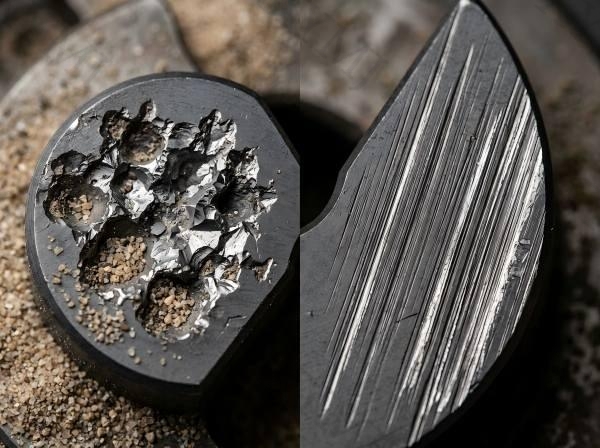
What you see on the surface after abrasive wear is telling: uniform scratches, gradual material thinning, and rounded-off edges. It’s progressive and relatively predictable.
The material property that matters most here is hardness specifically, the hardness ratio between the abrasive and the carbide. Once the abrasive exceeds roughly 1.2× the hardness of the carbide, wear accelerates sharply.
What Is Erosive Wear in Carbide?
Erosive wear is impact-driven. Instead of particles sliding across a surface, they strike it, carried by a fluid stream, pneumatic flow, or slurry. The energy transferred at impact is what removes material, not sustained sliding contact.
The key variable that separates erosion from abrasion mechanically is impact angle, and it changes everything about how carbide fails.
At low angles (under 30°), the particles have a significant horizontal velocity component. The dominant failure mechanism looks similar to cutting or plowing, comparable in some ways to abrasion. In this regime, harder carbide grades tend to perform well.
At high angles (60° and above), particles hit more or less perpendicularly. The energy transfer is concentrated, and failure comes from micro-cracking and subsurface fracture rather than surface cutting. In this regime, hardness alone isn’t enough, toughness becomes the controlling factor, and a brittle, high-hardness grade can actually perform worse than a tougher one.
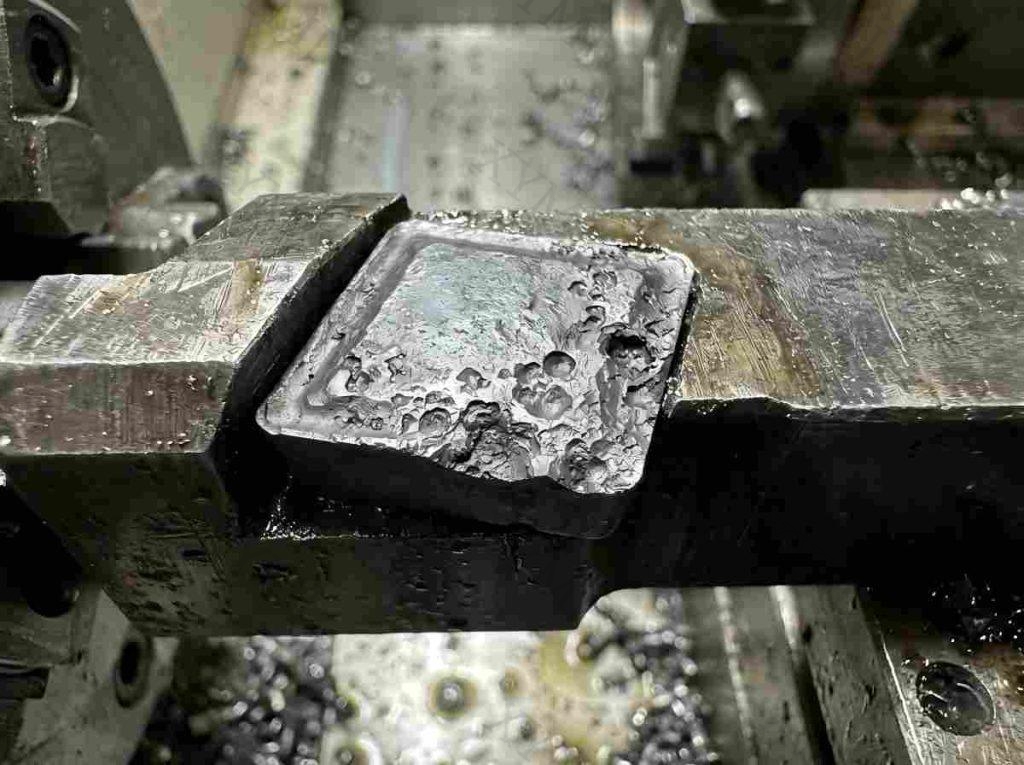
Erosion damage looks different from abrasion: you’ll typically see pitting, cratering, and localized chipping rather than linear scratches. It tends to be more variable and concentrated near impact zones.
Common erosion environments include slurry pump casings, abrasive waterjet nozzles, oil and gas choke valves, drilling tool flow passages, and pipe elbows carrying particulate-laden fluid.
Carbide Erosion vs. Abrasion: A Direct Comparison
| Abrasive Wear | Erosive Wear | |
| Mechanism | Sliding/cutting particle contact | Particle impact |
| Primary material property | Hardness | Hardness + Toughness (angle-dependent) |
| Failure appearance | Uniform scratches, gradual thinning | Pitting, cratering, localized chipping |
| Key test standard | ASTM G65 (dry sand), ASTM B611 (slurry) | ASTM G76 |
| Impact angle sensitivity | Low | High |
| Preferred carbide structure | Fine grain, low binder | Coarser grain, higher binder |
The table shows the practical consequence of confusing the two: the “preferred carbide structure” rows point in opposite directions. A fine-grain, low-cobalt grade that handles abrasion well is likely to be more brittle, and more vulnerable to the micro-cracking that drives erosive failure at high impact angles.
How Erosion and Abrasion Affect Tungsten Carbide Grade Selection
This is where the distinction becomes a real engineering decision.
For predominantly abrasive conditions, the priority is hardness. That means lower cobalt content (typically in the 6–8% range) and finer grain sizes (submicron to fine). The high carbide volume fraction resists micro-cutting, and the fine grain structure limits the size of any material that gets removed. The trade-off is reduced toughness, these grades are more susceptible to cracking under impact.
For predominantly erosive conditions, particularly where impact angles are variable or high, toughness needs to be balanced against hardness. That shifts the grade toward higher cobalt content (10–15%) and somewhat coarser grain sizes. The increased binder phase absorbs impact energy and resists crack propagation, the failure mode that dominates perpendicular or near-perpendicular particle strikes.
Neither variable, cobalt content nor grain size, works in isolation. Increasing cobalt raises toughness but lowers hardness. Increasing grain size also trades hardness for toughness. Grade selection is always a balance between the two, calibrated to the actual wear environment.
For reliable validation, ASTM G65 (dry rubber wheel abrasion) and ASTM B611 (wet abrasion) are standard for abrasion testing, while ASTM G76 covers solid particle erosion. Running both on candidate grades gives a clearer picture of how they’ll perform if your application involves elements of each.
Abrasion vs. Erosion in Different Industries and Applications
Abrasion-dominated applications:
- Stamping and forming dies (three-body contact between carbide, workpiece, and trapped debris)
- Powder compaction tooling
- Wood, stone, and composite cutting
- Agricultural tillage blades and soil-contact wear parts
Erosion-dominated applications:
- Hydrocyclone components (liners, vortex finders, apex nozzles)
- Abrasive waterjet nozzles
- Slurry pump impellers and casings
- Oil and gas choke valves and flow-control components
- Pneumatic conveying system elbows
Mixed wear environments where both mechanisms are active simultaneously include mining drill bits, longwall coal shearer picks, and directional drilling tools. These are harder to optimize for, and they’re covered next.
What Happens When Carbide Faces Both Erosion and Abrasion at Once?
Mixed wear conditions are more common in practice than either mechanism in pure form, and they’re also the most likely to produce premature failure when the grade hasn’t been selected with both in mind.
The two mechanisms reinforce each other in a specific way: abrasive wear roughens the surface, which increases the effective contact area for subsequent particle impacts, accelerating erosion. At the same time, erosion introduces micro-cracks and subsurface damage that propagate faster under the compressive and sliding stresses of abrasion. The result is a combined wear rate that’s higher than either mechanism alone.
In these conditions, defaulting to a very high-hardness, low-cobalt grade is a risk. The brittleness that comes with low binder content creates a starting point for crack propagation, and once surface damage from erosion initiates those cracks, abrasive contact can drive them deeper. Composite carbide grades which combine a high carbide volume fraction with a binder distribution designed to interrupt crack paths tend to perform more consistently across mixed wear environments than grades optimized for a single mechanism.
Research comparing tungsten carbide/cobalt, boron carbide, and composite carbide under both ASTM G65 and G76 conditions found that the composite grade produced the lowest wear rates across all tests — supporting the practical case for using multi-mechanism grades when the operating environment isn’t clearly one or the other.
If the application involves mixed wear, it’s worth running both G65 and G76 on shortlisted grades before committing to a specification. Single-test data from one mechanism won’t predict real-world behavior accurately enough.
Choosing the Right Grade Starts With Understanding the Wear Mode
Getting the wear mechanism right is the first step in any carbide grade decision. A grade that excels in abrasion testing can fail unexpectedly under erosive conditions, not because the material is inferior, but because it was selected for the wrong problem.
If you’re working through a grade selection for an application with known or uncertain wear conditions, contact the XYMJ technical team for grade recommendations backed by application-specific testing data.
FAQs
What is the main difference between erosion and abrasion in tungsten carbide?
Abrasion involves particles sliding across the carbide surface and cutting material away through sustained contact. Erosion involves particles striking the surface at velocity, with impact energy driving material removal. The mechanisms look different, fail differently, and require different material properties to resist.
Which carbide grade offers the best erosion resistance?
There’s no single answer, it depends on impact angle. For low-angle erosion, harder fine-grain grades perform well. For high-angle or perpendicular impact, tougher grades with higher cobalt content are more appropriate. Composite carbide grades that balance both properties are often the best choice when impact angle is variable.
Does higher cobalt content improve abrasion resistance or erosion resistance?
Higher cobalt improves toughness and impact resistance, which benefits erosion resistance (particularly at high angles). It reduces hardness, which works against abrasion resistance. For abrasion, lower cobalt grades with finer grain sizes are preferred.
What ASTM standards are used to test carbide abrasion and erosion?
ASTM G65 (dry sand/rubber wheel) and ASTM B611 (wet abrasion slurry) are standard for abrasion testing. ASTM G76 is the standard for solid particle erosion testing.
Can one tungsten carbide grade resist both abrasion and erosion?
Not optimally, the two mechanisms pull grade properties in different directions. Composite carbide grades offer a practical compromise in mixed-wear environments, but for high-severity single-mechanism applications, a grade optimized specifically for that condition will generally outperform a compromise grade.