
Tungsten Carbide vs Tool Steel: Which is Better for Your Tooling Needs?
In modern industrial manufacturing and machining, choosing the right material is a make-or-break decision for any project. Your choice of material directly dictates product lifespan, machining efficiency, and overall cost control. Among the vast array of engineering materials, Tungsten Carbide and Tool Steel are the two most frequently compared.
While both are indispensable, “hardcore” materials in the industrial world, their physical properties are worlds apart. Tungsten Carbide is renowned for its unrivaled hardness, whereas Tool Steel is celebrated for its exceptional toughness. In this post, we will deliver an in-depth comparison of tungsten carbide vs tool steel across dimensions such as hardness, toughness, wear resistance, and cost to help you make the smartest choice for your next project.
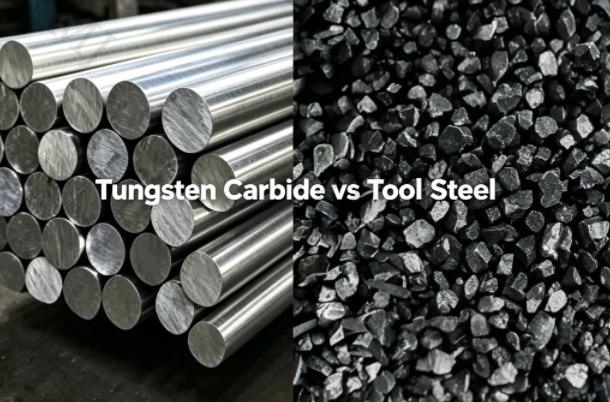
Table of Contents
What is Tungsten Carbide?
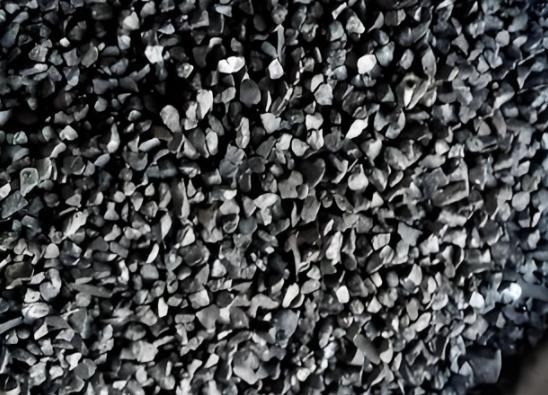
Strictly speaking, Tungsten Carbide (often simply referred to as Carbide) is not a traditional metal, but rather a “cermet” (ceramic-metal) composite produced via powder metallurgy. It consists primarily of ultra-hard, micron-sized tungsten carbide particles as the hard phase, sintered at high temperatures with a cobalt or nickel binder phase.
Core Advantages: Extreme hardness (second only to diamond), excellent red hardness (resists softening at elevated temperatures), and outstanding compressive strength.
Common Applications: High-feed CNC milling cutters, solid carbide drills, wire drawing dies, mining drill bits, and high-wear blast nozzles.
What is Tool Steel?
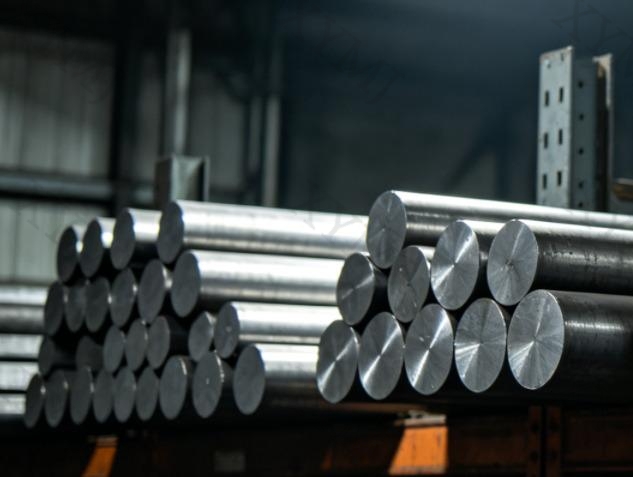
Tool Steel is a high-carbon alloy steel specifically engineered to manufacture cutting tools, stamping dies, and wear-resistant components. By incorporating alloying elements such as tungsten, chromium, vanadium, and molybdenum into a carbon steel base, followed by precise heat treatment (quenching and tempering), tool steel achieves highly versatile and superior mechanical properties.
Depending on the application scenario, the tool steel family includes several well-known grades:
Cold-Work Tool Steels (e.g., D2, O1): Formulated for maximum wear resistance at room temperature.
High-Speed Steels (e.g., M2, M42): Used for high-speed cutting while maintaining a sharp cutting edge.
Hot-Work Tool Steels (e.g., H13): Specifically designed for high-temperature environments like aluminum die-casting or hot forging.
Key Differences: Tungsten Carbide vs. Tool Steel
When comparing tungsten carbide and tool steel, we should not talk about the superiority of one material over another but compare them according to mechanical characteristics:
1. Hardness & Wear Resistance
Winner: Tungsten Carbide.
Tungsten carbide typically boasts a Vickers hardness between 1,500 and 2,000+ HV. In contrast, even a premium high-speed tool steel after top-tier heat treatment tops out around 700 to 900 HV (approx. 60–66 HRC). Consequently, when machining highly abrasive materials, tungsten carbide tools can outlast tool steel by 5 to 20 times.
2. Toughness & Impact Resistance
Winner: Tool Steel.
While tungsten carbide is extremely hard, it is also highly brittle. Under severe impact, mechanical vibration, or bending stress, carbide is highly prone to chipping or catastrophic fracturing. Conversely, tool steel possesses exceptional internal toughness, allowing it to absorb significant impact energy without breaking—making it ideal for interrupted cutting or heavy-duty stamping.
3. Temperature Resistance and Red Hardness
As temperature during cutting increases above 600 degrees centigrade, annealing of conventional tool steels occurs, resulting in the loss of their hardness. On the other hand, tungsten carbide possesses excellent red hardness (heat hardness), which makes it able to retain its hardness at very high temperatures, up to 800 degrees to 900 degrees centigrade. This property makes tungsten carbide the preferred material for high-speed machining (HSM).
4. Machinability and Difficulty of Customization
Before final heat treatment, tool steel can be easily shaped and formed into any complicated geometry using standard machining processes such as turning, milling, drilling, or shaping. In contrast, tungsten carbide becomes extremely hard after being processed by sintering, requiring diamond tools to grind it down.
At-a-Glance Comparison: Tungsten Carbide vs. Tool Steel
To help you weigh your options quickly, here is a direct comparison of their core physical properties:
| Property / Metric | Tungsten Carbide | Tool Steel |
| Core Advantage | Extreme hardness & ultra-long wear life | High toughness, impact resistance, shatter-proof |
| Vickers Hardness (HV) | 1,500 – 2,000+ | 700 – 900 (Post-heat treatment) |
| Brittleness | High (Prone to chipping; avoid high impact) | Low (Withstands heavy impact and vibration) |
| Heat Resistance | Outstanding (Retains hardness up to 900°C) | Moderate (Prone to annealing/softening at high temps) |
| Machinability | Extremely difficult (Requires EDM or diamond grinding) | Good (Easily machined prior to heat treatment) |
| Initial Material Cost | High | Affordable to Moderate |
Tungsten Carbide vs Tool Steel Performance in Real-World Applications
In actual industrial production, physical properties translate directly into shop floor efficiency. Here is how both materials perform across core application scenarios:
Cutting Tools
In metal cutting and CNC machining, machining speed and tool life are the ultimate metrics:
Tungsten Carbide – The High-Speed, High-Efficiency Workhorse:
Thanks to its excellent red hardness, it maintains its cutting edge at 800°C, allowing for much higher Surface Feet per Minute (SFM). Its extreme wear resistance yields a lower wear rate, ensuring dimensional consistency during long production runs. It is the definitive tool for uninterrupted, automated assembly lines where minimizing tool-change frequency is paramount.
Tool Steel – The Reliable Backup for Complex and Low-Speed Conditions:
It is far better suited for low-to-medium speed cutting, setups with low machine rigidity (prone to vibration), and interrupted cutting (intermittent machining) where carbide would otherwise chip.
Dies & Stamping
Die failure is usually caused by wear or cracking, which dictates material selection:
Carbide Dies (High Precision, Ultra-Long Life):
Ideal for precision stamping dies—such as those used for electronic lead frames and motor stators/rotors—that require millions of strokes and stringent burr control. While initial fabrication is challenging, they exhibit virtually zero wear over time.
Tool Steel Dies (Complex Geometries, Anti-Cracking):
Best suited for large automotive body panel stamping, or highly complex injection molds and die-casting dies. The superior internal toughness of tool steel prevents the die from catastrophic cracking under massive internal clamping forces.
High-Impact & Severe Load Environments
When equipment is subjected to violent mechanical vibration or intermittent impacts (e.g., cold heading, heavy-duty forging, rock crushing, and mining):
Tool Steel: Offers a massive safety margin. Its excellent fracture toughness absorbs impact energy, meaning it will deform slightly rather than shatter.
Tungsten Carbide: Despite its highly wear-resistant surface, its lack of ductility makes it highly susceptible to catastrophic brittle fracture along micro-crystalline grain boundaries under heavy impacts.
Total Cost of Ownership Analysis: Is Carbide Truly More Expensive?
If you only compare the initial purchase price (upfront material cost) and the subsequent EDM/diamond grinding costs, tungsten carbide is undeniably more expensive per kilogram than tool steel. However, mature manufacturing enterprises focus on Total Cost of Ownership (TCO) and Return on Investment (ROI).
To visualize this, consider the following formula:
Total Production Cost = Material/Tool Cost + Downtime Losses (Idle Line Cost)/Total Yield of Qualified Parts
Tungsten Carbide: Though the initial investment is high, its lifespan is typically 5 to 20 times longer than that of tool steel. This drastically increases production line uptime and minimizes labor and capacity losses caused by frequent tool changes and machine calibration.
Tool Steel: It features a lower upfront cost and rapid machining turnaround. However, when faced with high-volume, high-intensity production, it wears down quickly. Frequent tool maintenance, replacement, and re-heat-treating will rapidly erode its initial cost advantage.
For mass production or automated continuous operations, the amortized cost of tungsten carbide per unit is often far lower than that of tool steel. Conversely, for small-batch prototyping and the R&D phase, tool steel remains the more economically flexible choice.
Tool Steel vs Tungsten Carbide: When to Choose Which?
How do you precisely match these materials to your actual production needs? Here is a professional selection guide based on specific machining scenarios and process requirements:
Choose Tungsten Carbide when you need:
Mass Production & Automation:
In automobile assembly lines or 3C electronic manufacturing facilities, any downtime resulting from frequent tool replacement leads to huge capacity wastage. Tungsten carbide ensures superior process stability and unparalleled long-life spans, making it indispensable in limiting tool changeovers and downtime.
For Machining Tough/Highly Abrasive Materials:
For machining tough materials such as titanium alloy, and superalloys or highly abrasive materials such as fiberglass and carbon fiber, traditional steel quickly becomes blunt due to abrasion. Only tungsten carbide can retain its sharpness.
High Dimensional Stability & Wear Resistance:
This is the case when considering components that require stringent dimensional accuracy and wear resistance – such as wire drawing dies, high-pressure blast nozzles, or precision measuring tools (gauge block, plug gauge). They require resistance to wear while maintaining micron-level dimensions.
Choose Tool Steel when you need:
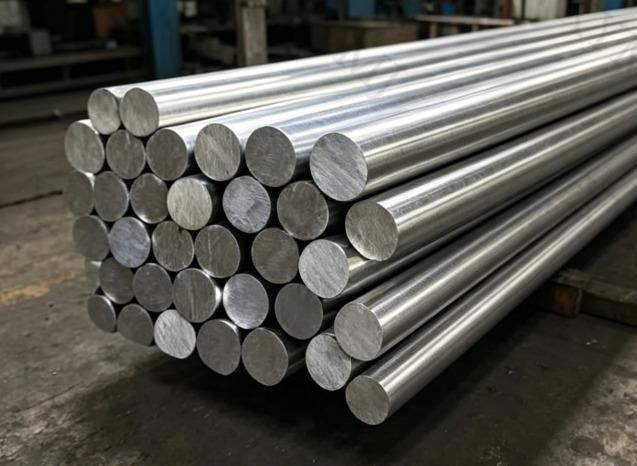
To Withstand Interrupted Cutting or High-Impact Loads:
This can be seen with large automotive panel stamping dies, thick plate shear blades, and rock crushers’ hammer bits. In such circumstances, there is a need for material that can withstand many “hard-on-hard” hits. If old machines have insufficient stiffness and create vibrations, then using tool steel would be wise.
To Manufacture Massive, Large-Scale Components:
Such as large injection molds or heavy forging dies. Making an entire massive component out of tungsten carbide is not only financially prohibitive, but also technologically challenging due to the limits of powder metallurgy pressing and sintering equipment. Tool steel is easily forged and shaped into large dimensions, giving it a clear advantage for big components.
R&D Prototyping, Small Batches, or Trial-and-Error Phases:
During product development, part geometries, tool angles, or mold cavities often require frequent post-production adjustments, welding repairs, or secondary machining. The excellent machinability and repairability of tool steel, both before and after heat treatment, will save you substantial R&D time and money.
Conclusion
Ultimately, the choice between Tungsten Carbide vs. Tool Steel is a classic trade-off between wear resistance and toughness. Your final material selection should always be anchored to five core variables: load type, wear severity, impact conditions, budget, and production volume.
Looking for Premium Tungsten Carbide Solutions?
With your next task needing the utmost resistance against wear and tear and a highly durable life span, our company is willing to assist you.
As one of the top manufacturers of high-end tungsten carbide (cemented carbide), XYMJ specializes in providing powder metallurgy sintering and high-precision machining as per your specific needs.
Contact us today to get expert material selection consulting and a highly competitive factory-direct quote!