
Tungsten Carbide Cutting Tools: A Deep Dive into Performance and Applications
In modern precision manufacturing, machining speed, accuracy, and tool life are the three core factors that determine a company’s profitability. With the increasing demand for hard-to-machine materials in industries such as aerospace, automotive, and precision mold making, traditional plastic or high-speed steel (HSS) tools are no longer able to meet the requirements of such demanding working conditions.
As the “hard currency” of the industrial world, tungsten carbide cutting tools have become an indispensable productivity tool in modern CNC machining centers due to their outstanding physical properties. This article provides an in-depth analysis of the core advantages, main categories, industry applications, and key selection guidelines for purchasing tungsten carbide tools.
Table of Contents
Why Are Carbide Cutting Tools Widely Used in Machining?
Carbide cutting tools have come to be used extensively in machining due to their excellent combination of qualities that make them suitable for use in highly demanding production operations.
1. Hardness and wear resistance
Carbide is a much harder material than traditional tool steels, which makes carbide tools retain a sharp cutting edge over a long period of time, thus preventing wear from machining of hard metals such as steel and cast iron.
2. Heat resistance
Machining produces large amounts of heat during cutting processes. Heat does not affect the hardness of carbide cutting tools, and therefore they can be used in CNC high-speed machining operations.
In comparison to HSS tools, carbide tools have a much longer life span, which means fewer changes to the tool and less down time.

3. Appropriate for high-speed machining
Carbide tools facilitate increased cutting speed and feed rate, leading to increased productivity.
4. Inexpensive production
The cost of these tools may be a little higher initially, but due to the increased longevity and efficiency, they can save money in the long run.
Main Types of Carbide Cutting Tools
According to different machining requirements, carbide cutting tools can be divided into several categories. Each type is optimized for specific processes to improve efficiency and machining stability.
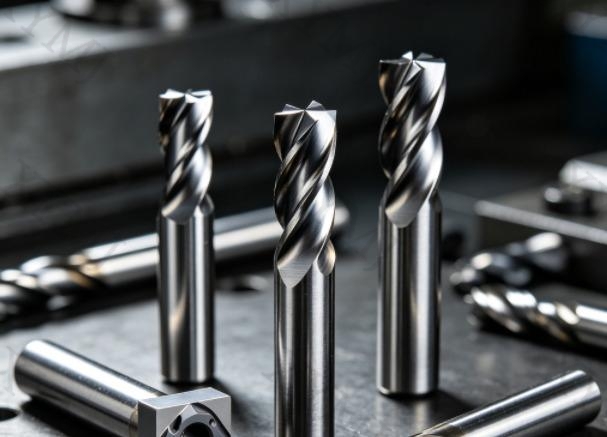
Carbide End Mills
Used for contouring, slotting, and complex 3D surface machining. They are one of the most common tools in CNC machining and offer high rigidity and wear resistance, making them suitable for high-speed cutting of steel, stainless steel, and aluminum alloys.
Carbide Drill Bits
Used mainly for precise drilling applications, particularly for drilling into hard materials. Carbide drill bits offer better speed, durability, and stability than HSS drill bits.
Carbide Inserts
Commonly employed in turning and milling operations. Carbide inserts have a replaceable structure that aids in lowering tooling costs and increasing productivity.
Carbide Reamers
Used for precision hole finishing after drilling to improve dimensional accuracy and surface finish. They are commonly applied in high-precision component manufacturing.
Custom Carbide Tools
Designed according to specific machining requirements, including tool dimensions, edge geometry, and coating options. They are suitable for complex or non-standard machining applications.

Application Areas of Carbide Cutting Tools
Since they are highly hard, resistant to wear, and stable at high temperatures, carbide cutting tools find extensive applications in different industrial sectors requiring precision processing technologies.
Aerospace Industry
High-performance materials like titanium alloys and nickel-based superalloys are used in the aerospace industry, which imposes very high expectations regarding processing. The aerospace industry applies carbide cutting tools that are highly efficient in processing aircrafts’ structural parts and load-carrying elements because of their good heat resistance and shock resistance.
Mold Manufacturing Industry
Carbide cutting tools are commonly employed in mold machining processes that include cavity machining, mold core and surface machining. The use of carbide cutting tools is appropriate because molds require very fine finishes and very high accuracy. Carbide cutting tools provide very good machining results, reduce polishing, and increase manufacturing efficiency.
Automotive Manufacturing Industry
Carbide tools are mainly applied in the automotive industry in order to perform machining operations on engine blocks, crankshafts, transmissions, and other structural parts. Due to the tendency toward the use of light and powerful cars, more advanced requirements for precision processing are expected. Carbide tools work effectively and stably during high-load processing cycles, providing better results.

Metal Industry
In metal machining processes, carbide tools are well suited for machining different ferrous and non-ferrous materials like steel and cast iron. These cutting tools provide consistent and reliable cutting performance and are capable of lasting for many hours when operated under high load.
CNC Machining Industry
In CNC machining centers, carbide tools are standard cutting tools. They are mainly used in highly precise and efficient mass machining processes where constant performance is required over a long period of time. They can be utilized in consumer electronic components machining, medical devices machining, etc.
Carbide Cutting Tools vs. High-Speed Steel (HSS) Tools
In industrial machining, the differences between carbide and high-speed steel (HSS) are quite significant:
| Comparison Item | Carbide Cutting Tools | HSS Tools |
| Hardness | Higher | Moderate |
| Wear Resistance | Excellent | Average |
| High-Temperature Resistance | Excellent | Relatively weak |
| Cutting Speed | High-speed machining | Low-speed machining |
| Tool Life | Longer | Shorter |
| Cost | Higher | Lower |
Overall, in high-efficiency and high-precision machining applications, carbide cutting tools offer a clear advantage.
How to Choose the Right Carbide Cutting Tools?
In practical machining applications, selecting the right carbide cutting tools is crucial for machining efficiency, product quality, and tool life. The decision can generally be made based on the following key factors:
1. Workpiece Material Type
Different materials require different tool performance. For example, steel and cast iron demand high strength and wear resistance, while stainless steel and high-temperature alloys require better heat resistance and anti-adhesion properties. For softer materials like aluminum, tools with sharper cutting edges and excellent chip evacuation are preferred.
2. Coating Type
Tool coatings play a critical role in performance enhancement. Common coatings such as TiN, TiAlN, and AlTiN can significantly improve wear resistance, oxidation resistance, and high-temperature stability. The right coating is especially important in high-speed machining or dry cutting conditions.
3. Tool Geometry
Parameters related to geometry, like helix angle, flute count, rake angle, and clearance angle, have an influence on the machining process directly in terms of efficiency, chip evacuation, and surface finish. High helix angle tools are appropriate for high-speed finishing operations, whereas a low flute count is preferred in roughing operations under heavy cuts.
4. Machining Stage
Depending on the stage of machining, different tool performance is needed. Roughing operations require tools that perform efficiently in terms of their material removal rate and durability, while finishing operations require attention to the quality of the cut surface and dimensional accuracy of the product. Thus, selecting appropriate tools depending on the machining stage is critical.
5. Manufacturer’s Competence
Choosing the manufacturer that can provide stable production capability, quality control systems, and customizing options is very important in order to achieve successful outcomes of machining.
Summary
Tungsten carbide cutting tools are indispensable elements of manufacturing technology due to their high strength and resistance to temperature changes. It means that any manufacturing company will benefit greatly if it chooses the best carbide cutting tools and thus can reduce its expenses.