
Are all Drill Bits Tungsten Carbide? The Truth You Should Know
When choosing drill bits, many people ask: “Are all drill bits tungsten carbide?”
This is a bit like thinking “the fastest running shoes work for every sport”; it sounds right, but it isn’t.
Tungsten carbide is indeed very strong, but it’s more like a “professional athlete,” not an all-purpose tool. After all, you wouldn’t drive a race car just to go grocery shopping.
In reality, drill bits have different roles: some are durable and affordable, some are designed for hard materials, and others focus on precision. The right choice boosts efficiency, while the wrong one can lead to failure.
The key isn’t how “advanced” the material is, but whether it fits your application. Next, let’s quickly break down the real differences between drill bit materials.
Core Answer: Are all drill bits tungsten carbide?
Are all drill bits tungsten carbide? The answer is absolutely No.
Not all drill bits are made of tungsten carbide. In fact, most drill bits on the market are made from several common materials:
- High-Speed Steel (HSS)
- Cobalt Steel
- Tungsten Carbide
- Diamond
Each material differs significantly in hardness, heat resistance, wear resistance, and cost, making them suitable for different machining applications.
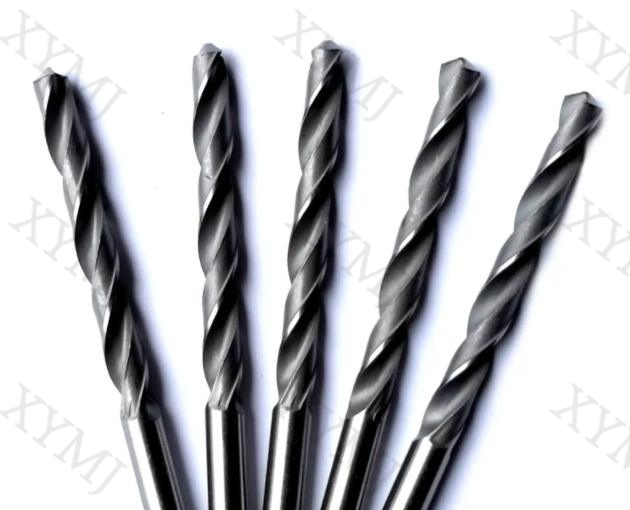
What are Common Drill Bit Materials?
In real machining work, different materials require different types of drill bits. Using a “one-size-fits-all” drill bit often leads to low efficiency, fast wear, or even machining failure. This section introduces several of the most common drill bit materials to help you quickly understand their characteristics and choose the right one for your application more scientifically.
1. High-Speed Steel Drill Bits (HSS Drill Bits)
High-speed steel (HSS) is one of the most common and widely used drill bit materials. It is frequently seen in hardware stores and general machining applications. Its main advantage is low cost combined with good toughness, which makes it less likely to break during use.
In practice, HSS drill bits are commonly used for drilling wood, plastic, and soft metals such as aluminum. While they are not ideal for hard materials, they are highly cost-effective and suitable for everyday maintenance, basic manufacturing, and general-purpose drilling tasks.
2. Tungsten Carbide Drill Bits
Tungsten carbide drill bits are industrial-grade high-performance tools known for their extremely high hardness and excellent wear resistance, far exceeding that of HSS and cobalt steel.
These drill bits are ideal for high-speed and high-precision machining environments, commonly used in CNC machining centers and mass industrial production. When working with hard materials such as alloy steel or high-strength metals, tungsten carbide drill bits offer long tool life and stable machining accuracy.
However, because of their hardness and relative brittleness, they require more stable operating conditions and are generally used in professional industrial applications rather than general-purpose drilling.

3. Cobalt Drill Bits
Cobalt drill bits are an improved type of high-speed steel drill bits, which contain additional cobalt to enhance their ability to resist heat and wear.
Since heat generation is inevitable in metal drilling operations, regular HSS drill bits tend to become dull after extended use. In contrast, cobalt drill bits function more efficiently in high-heat environments and can maintain steady cutting action throughout the process. Thus, they are highly efficient when dealing with stainless steel or other alloys.
In the metalworking sector, cobalt drill bits are regarded as a dependable “improved option.”
4. Diamond Drill Bits
Diamond drill bits are specialized drill bits that are designed to machine very hard and brittle materials, hence being regarded as premium products.
Diamond drill bits are used in the processing of glass, ceramics, and stones, which cannot be easily drilled by ordinary metal drill bits due to their hardness. The hardness of diamond drill bits allows them to produce accurate and stable cutting operations.
For this reason, they are utilized primarily in building works, decorations, and other industrial applications where metals are not involved.
Advantages and Disadvantages of Tungsten Carbide Drill Bits
Tungsten carbide drill bits are specialized tools that are utilized in industrial manufacturing works. They are preferred compared to ordinary high-speed steel and cobalt drill bits due to their hardness and efficiency. Nevertheless, there are certain drawbacks associated with tungsten carbide drill bits.
Advantages
1. Extremely high hardness, ideal for heavy-duty machining
Tungsten carbide has a much higher hardness compared to most standard metal materials and can easily manage heavy-duty machining requirements. Regardless of hardened-allow steel, quenched steel, and all sorts of other harsh industrial materials, the carbide drill bits provide stable cutting performance with minimal wear, itself a great asset. This is the most significant goal that creates high usage rates for CNC machining centers and precision manufacturing industries.
2. Longer tool life and better long-term cost efficiency
Even though a tungsten carbide drill bit is relatively expensive in the beginning, its high wear-resistance feature means that it can serve for an extended period during machining processes.
In a mass-production setting, this translates into infrequent tool replacements, less machine idle time, and decreased production expenses.
3. High-speed cutting capability, improved productivity
Tungsten carbide maintains excellent thermal stability at high temperatures, meaning it does not easily soften or deform during high-speed cutting. As a result, it supports higher spindle speeds and feed rates.
This allows manufacturers to complete more work in less time, greatly improving production efficiency, especially in automated production lines and high-volume manufacturing systems.

Disadvantages
1. Relatively brittle and less impact-resistant
Although tungsten carbide is extremely hard, it has lower toughness compared to some other materials. It may chip or break under impact or unstable cutting conditions. Therefore, extra caution is required when used with handheld drills or low-rigidity equipment.
2. Higher cost
Due to complex raw materials and manufacturing processes, tungsten carbide drill bits are significantly more expensive than HSS or cobalt alternatives. They are better suited for high-value or mass production applications rather than low-cost, general-purpose use.
3. Higher equipment requirements
The use of tungsten carbide drill bits necessitates the use of rigid machines like CNC machines and industrial drillers. Any problems associated with vibrations and instability in terms of securing tools might lead to poor machining results as well as edge cracking.
Overall, the key advantages of tungsten carbide drill bits lie in their exceptional hardness, high wear resistance, and excellent high-speed machining capability. They are particularly suitable for industrial-grade, high-strength, and mass-production environments.
Although they require higher investment and more stable operating conditions, in the right applications, they deliver superior productivity and lower long-term operating costs, making them an indispensable tool in high-end manufacturing industries.
How to Choose the Right Drill Bit
Different materials require a different hardness, heat-resisting tolerance, wear resistance, or degree of compatibility. Proper selection increases efficiency and minimizes wear of tool, while improper selection can damage both bit and workpiece too early.
Below is a simple selection guide:
| Application Scenario | Recommended Drill Bit Type | Notes |
| Wood, Plastic | HSS Drill Bits | Best for soft materials, cost-effective and easy to use |
| General Metals (e.g. aluminum, mild steel) | HSS or Cobalt Drill Bits | HSS for light work, cobalt for better durability |
| Stainless Steel | Cobalt Drill Bits | Better heat resistance and longer tool life |
| High-Hardness Metals / Mass Production | Tungsten Carbide Drill Bits | Ideal for CNC machining and high-precision industrial use |
| Glass / Ceramic / Tile | Diamond Drill Bits | Designed for brittle and ultra-hard materials |
Recommendation: XYMJ Tungsten Carbide Drill Bits
XYMJ specializes in the manufacture and sale of tungsten carbide drill bits that are used for industrial machining purposes.
Our drill bits are made using high-quality carbide material and advanced CNC grinding technology to guarantee durability, good wear resistance, and high performance during high-speed machining operations.
Our drill bits have been found to be very useful when it comes to CNC machining processes, the machining of stainless steel, and machining of difficult-to-machine metals.
We are also ready to manufacture custom-made drill bits of any desired size and design.
XYMJ is the place to go if you need quality tungsten carbide drill bits.
FAQs about Drill Bits
1. How to tell if drill bits are tungsten carbide?
Tungsten carbide drill bits are usually very hard, heavy, and brittle-looking compared to HSS bits. They often have a gray matte finish and may be marked with “Carbide” or “Tungsten Carbide” on the shank. They also resist wear much better but can chip if dropped.
2. What is the difference between carbide and tungsten carbide drill bits?
“Carbide drill bit” is a general term, whereas “tungsten carbide drill bit” is a specific variety of carbide tool consisting of concoctions of tungsten and carbon. Most frequently, the “carbide drill bits” in industrial language eventually get narrowed to “drills made from tungsten carbide.”
3. What is the strongest material for a drill bit?
Tungsten carbide is considered the strongest drill bit material for most industrial uses due to its extreme hardness and wear resistance. Diamond-tipped drill bits are also considered stronger for a specialized use, but are used mostly for application in very hard non-metal materials, like glass and ceramics.

Related Products


